L&D 5.0 · Solutions

The world changed. The training room didn't.

Outside the training room, your people find answers in seconds. We design learning that works the same way: practice with AI, help at the moment of need, and short units that fit into the working day.

Example
18:42

The customer asks if the volume discount applies to an order of 40 units. What do I tell him?

The volume discount starts at 50 units. For 40 units you can offer free installation, which applies to every order this quarter.

Source: Q4 price list, p. 4
A familiar picture

Slide 47

A sales rep finishes day one of a two-day product seminar. A good trainer, polished slides, the usual binder. On her way home, a customer calls with a pricing question the seminar hasn't reached yet. She pulls into a parking lot, types the question into an AI assistant on her phone, and in under a minute has an answer she can use.

The next morning she walks back into the room and watches slide 47.

Nobody in this picture did anything wrong. But it shows the gap most organisations live with today. Outside the room, help arrives the moment you need it. Inside, we still ask people to learn everything up front, "just in case", and remember it weeks later.

And one more question: the answer came fast, but was it right for your pricing policy?

Yesterday, parking lot18:42

How is the new range priced for…

Answer in under 1 minute
Today, training room09:15Pricing is on slide 88
Information is no longer scarce. Attention is. And time.
The shift

From the classroom to the flow of work

The traditional model made sense when information was scarce and the trainer held it. L&D 5.0 starts from how adults actually learn today.

AspectTraditional trainingL&D 5.0 with MetisLearn
When people learnEverything up front, on a date set by the scheduleJust before, and at the moment of need
FormatTwo-day seminar with dozens of slides3 to 5 minute units, on mobile
PracticeOne role play in front of colleagues, if time allowsRepeated practice with AI, no audience, no risk
Support afterwardsThe binderAn AI assistant that answers from your approved content
Trainer's rolePresents contentDesigns, guides, coaches
MeasurementAttendance and a satisfaction surveyBehaviour on the job and business KPIs
Where we design

Five moments when people need to learn

The Five Moments of Need model (Gottfredson & Mosher) shows that the classroom mainly covers the first two. The other three happen on the job. That is where most value is lost, and where our methods focus.

Mostly in the classroomOn the job
  1. 1

    New

    Learning something for the first time

    MicrolearningAI avatar
  2. 2

    More

    Going deeper on what I know

    AdaptiveAI mentor
  3. 3

    Apply

    Putting it into practice

    AI role playAI assistant
  4. 4

    Solve

    Something isn't going as expected

    AI assistantAI agent
  5. 5

    Change

    The way I work is changing

    AI role playMicrolearningAI agent
The methods

Four methods, one system

Each method solves a different problem. We combine them based on your goal, your audience and the KPI you want to move.

AI Role Play

Practise difficult conversations with AI

The learner talks, in text or by voice, with an AI character: a demanding customer, an anxious patient, a team member resisting change. The character reacts to what they say, the way a person would. At the end they get specific feedback: what to keep and what to change.

Conversation skills are built through repetition. In a classroom each person gets maybe one attempt, in front of colleagues. With AI they can try ten times, whenever they want, with no audience.

Where it fits

  • Sales objection handling
  • De-escalation in healthcare
  • Feedback and tough conversations for managers
  • Customer service

What we measure

A score per behaviour, such as empathy, discovery questions and closing, and progress from attempt to attempt.

Example scenario
Mr PapadopoulosProcurement manager · AI character

Your competitor is 15% cheaper. Why should I stay with you?

I understand. Before we compare prices, what exactly does their offer include?

Next attempt: link after-sales service to a cost the customer already pays.
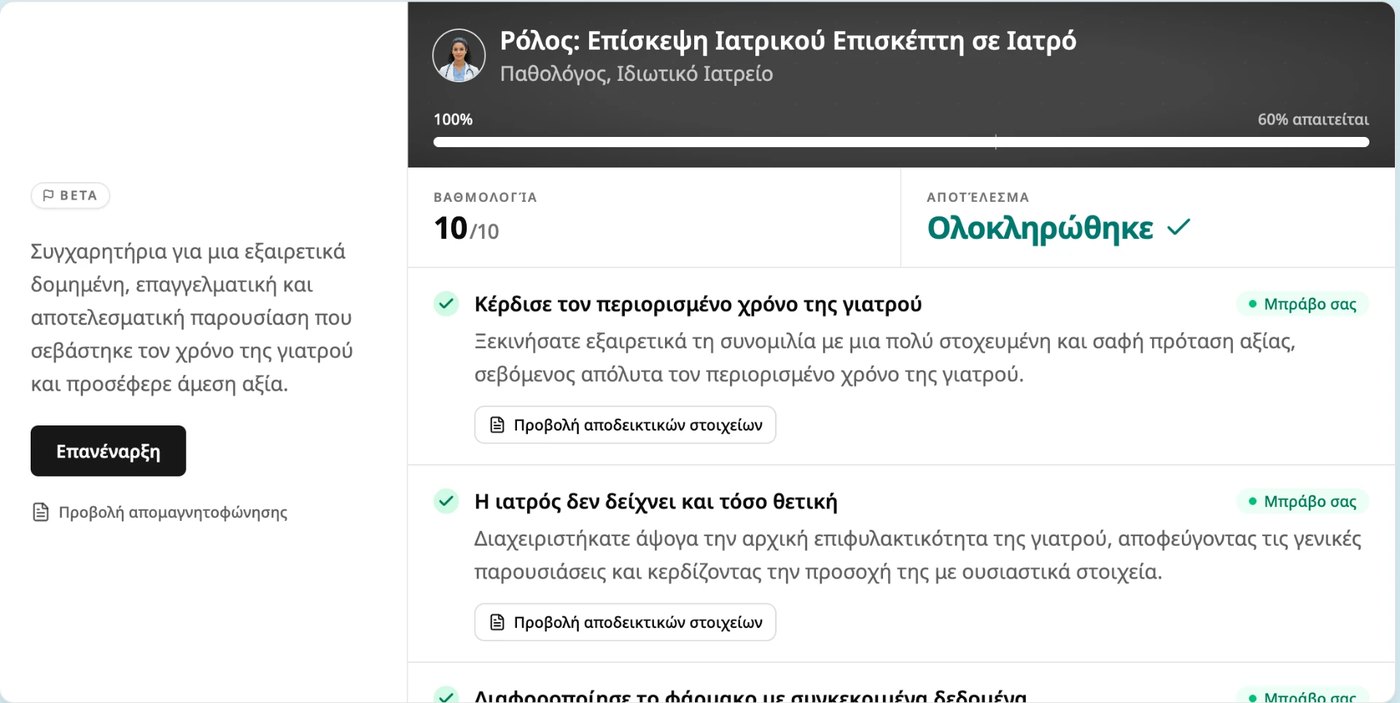
MetisLearn AI role play feedback screen with scores per behaviour
Agentic & Conversational AI

AI assistants and agents at the moment of need

An AI assistant connected to your company's approved content: price lists, procedures, manuals, the courses themselves. Employees ask in their own words and get an answer that cites its source.

AI agents go one step further. They don't wait to be asked: they send reminders, run short review questions, suggest the next unit or role play, and show managers where the team needs support.

Where it fits

  • Sales support
  • Onboarding new hires
  • Procedures and compliance
  • Support after training

What we measure

What people ask, where they get stuck, what content is missing. That data feeds the next training cycle.

Example: what the agent does during the week
  1. Mon 09:00Sends the new unit "Q4 pricing" (4 minutes)
  2. Wed 18:42Answers a volume discount question, citing the price list
  3. Thu 12:30Notices 6 in 10 ask the same thing and flags it to the L&D team
  4. Fri 10:003 review questions and a suggested AI role play on price objections
Immersive & AI Avatars

Immersive experiences and AI avatars

The learner holds a live video conversation with an AI avatar, makes decisions inside branching scenarios and sees the consequences. Interactive video and simulations bring real work situations to the screen, without the cost and risk of real life.

A face, a voice and a reaction that feel real make the experience memorable and easier to carry into the job.

Where it fits

  • Leadership and coaching
  • Safety and high-risk procedures
  • Hospitality and service
  • Onboarding with a virtual tour

What we measure

The decisions at each point in the scenario, and which choices need more practice.

Example scenario

What do you do first?

  • A. Explain that housekeeping is running late
  • B. Acknowledge the wait and ask what they need right now
  • C. Offer a discount straight away
Microlearning & Adaptive

Microlearning and adaptive learning

Units of 3 to 5 minutes, designed for mobile, each with one clear objective. The path adapts: people who already know something skip it, people who struggle get extra practice. Reviews arrive at spaced intervals so the knowledge sticks.

Attention is scarce. Short, focused units fit between two meetings and respect your people's time.

Where it fits

  • New product knowledge
  • Compliance and regulation
  • Power skills
  • Preparation before workshops

What we measure

Mastery per learning objective, not just completion rates.

Example unit
Unit 3 of 74 minutes

Which benefit of the new range matters most to a procurement manager?

  • The design
  • Lower maintenance cost over 3 years
  • The new colours

Next review: in 3 days

All together

One week with L&D 5.0

The same sales rep, the same new product. This time without a two-day seminar.

  1. Monday4′

    On her phone: the three key benefits of the new product.

    Microlearning
  2. Tuesday10′

    AI role play with a customer pushing on price. Second attempt, better result.

    AI role play
  3. Wednesday 18:421′

    A question on volume discounts. An answer from the official price list.

    Agentic AI
  4. Thursday15′

    A conversation with a procurement manager's AI avatar, before the real meeting.

    AI avatar
  5. Friday15′

    Coaching with her manager, based on the week's data.

    Human coaching

About 45 minutes across five days instead of two days away from work. See how it fits our 7-phase method

How we run it

The 7-phase L&D 5.0 loop

A closed loop from business diagnosis to measurable impact. Open one phase to see how it works in practice.

Name the business problem, root cause and KPI before designing learning.

Sector example: Retail: identify whether falling sales come from skill, process or incentives.

Open the DNA app (opens in a new tab)

From microlearning to micro-coaching

  1. L

    Learn 3-5 minutes

    One micro-unit, one skill.

  2. A

    Apply 24-48 hours

    One predefined micro-action at work.

  3. C

    Coach 10-15 minutes

    The experience, never the theory.

  4. R

    Reflect 2 minutes

    One written micro-commitment.

One sprint runs Learn, Apply, Coach, Reflect inside a single working week, then repeats on the next behaviour.

Asynchronous model: the learner sends a short voice or text reflection and receives a focused coaching reply. Live model: a 15-minute sprint turns one workplace attempt into the next practical commitment.

85% practice-led design

How design effort is distributed in a MetisLearn programmePractice and feedback 40%, application at work 25%, coaching and reflection 20%, content and theory 15%.85%practice led
  • 40% Practice and feedback
  • 25% Application at work
  • 20% Coaching and reflection
  • 15% Content and theory
Only a small share of a programme is content. Most of the design effort goes into doing, coaching and reflecting, which is where behaviour actually changes.

Designed against the forgetting curve

Retention over 30 days, traditional training against practice and micro-coachingTraditional training retention falls from 100% to roughly 10% within 30 days, while practice with micro-coaching holds around half of the content.0%25%50%75%100%day 01d7d14d30d
Practice plus micro-coaching Traditional one-off training
Cognitive load, spaced repetition and immediate feedback are why we design against the forgetting curve rather than around learning styles.
Where we apply it

Four business use cases

Onboarding

Employee Onboarding Programs That Cut Time-to-Proficiency

Most onboarding is an information dump followed by silence. We design structured first-90-days journeys that build confidence, capability and belonging, with managers equipped to coach from day one.

Outcomes

  • New hires productive 30 to 50% sooner
  • Lower regretted attrition in the first year
  • Consistent experience across sites and languages
  • Compliance covered without killing engagement

Deliverables

  • Onboarding journey map by role family
  • Scenario-based microlearning modules
  • Manager coaching playbook and check-in cadence
  • 30/60/90 capability checkpoints and dashboard

How we measure it

Time-to-proficiency, 90-day manager confidence rating, First-year retention, Completion and practice-attempt rates.

Inside the learning environment

Inside the learning environment

One view of the real learning experience, from microlearning and AI role play to case practice, feedback and analytics.

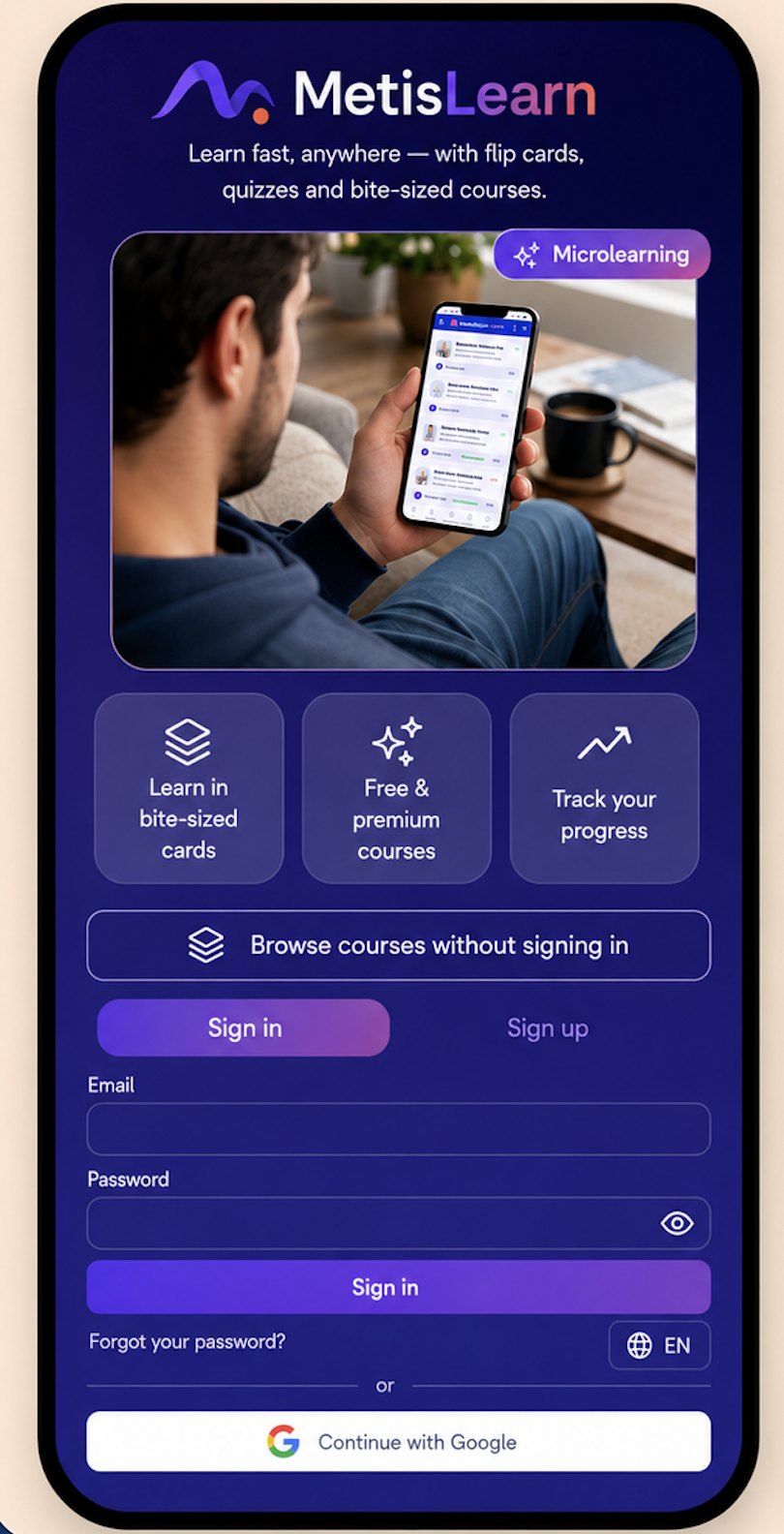
The MetisLearn mobile app home screen with flip cards, quizzes and bite-sized courses
Microlearning app

Microlearning on the phone

Flip cards, quizzes and three-minute lessons people finish between two meetings, with progress tracked.

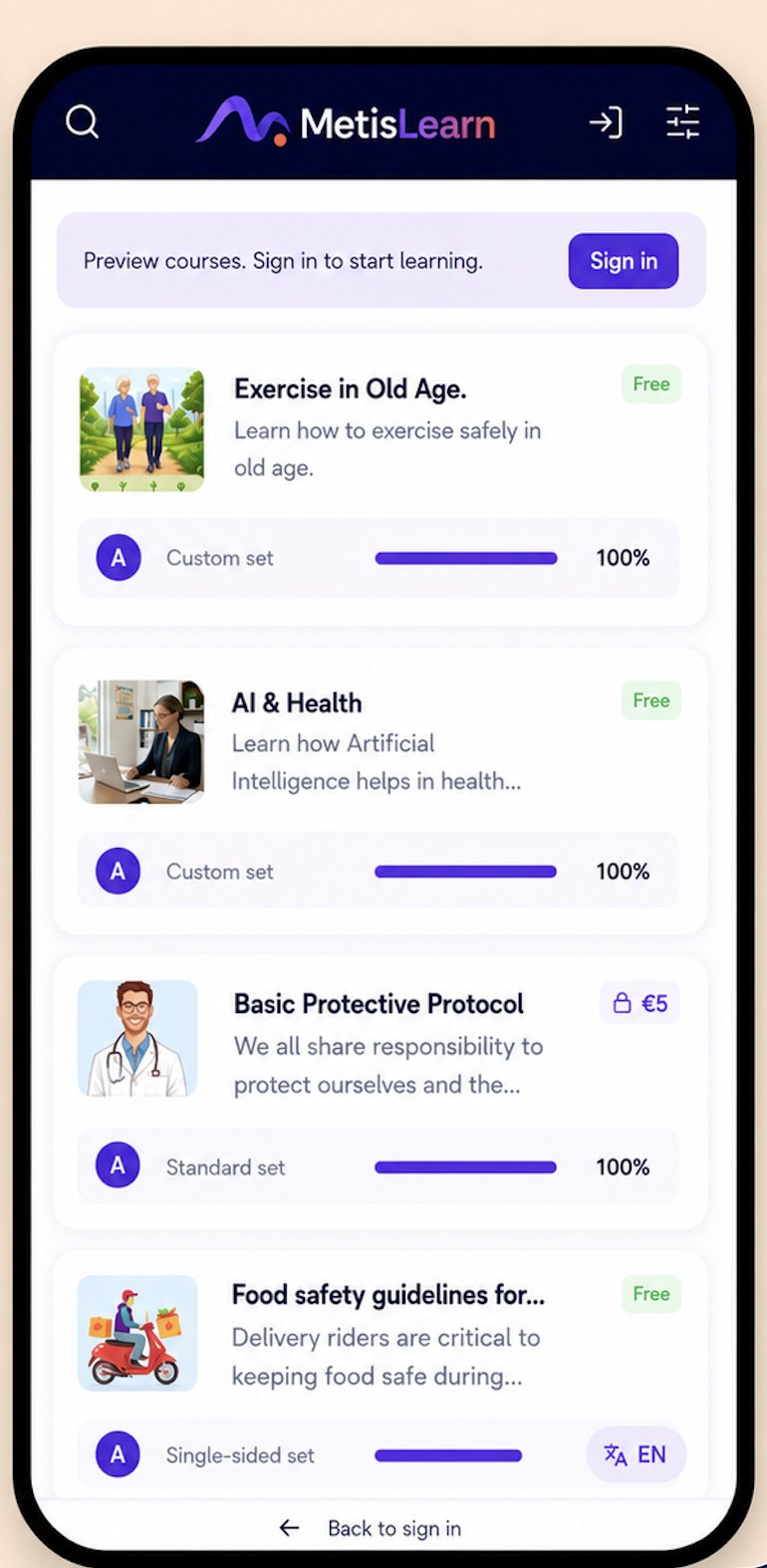
A course catalogue in the MetisLearn app showing free and premium courses with completion progress
eLearning library

A live course library

Role-based courses, free and premium, in Greek or English, with completion visible for every learner.

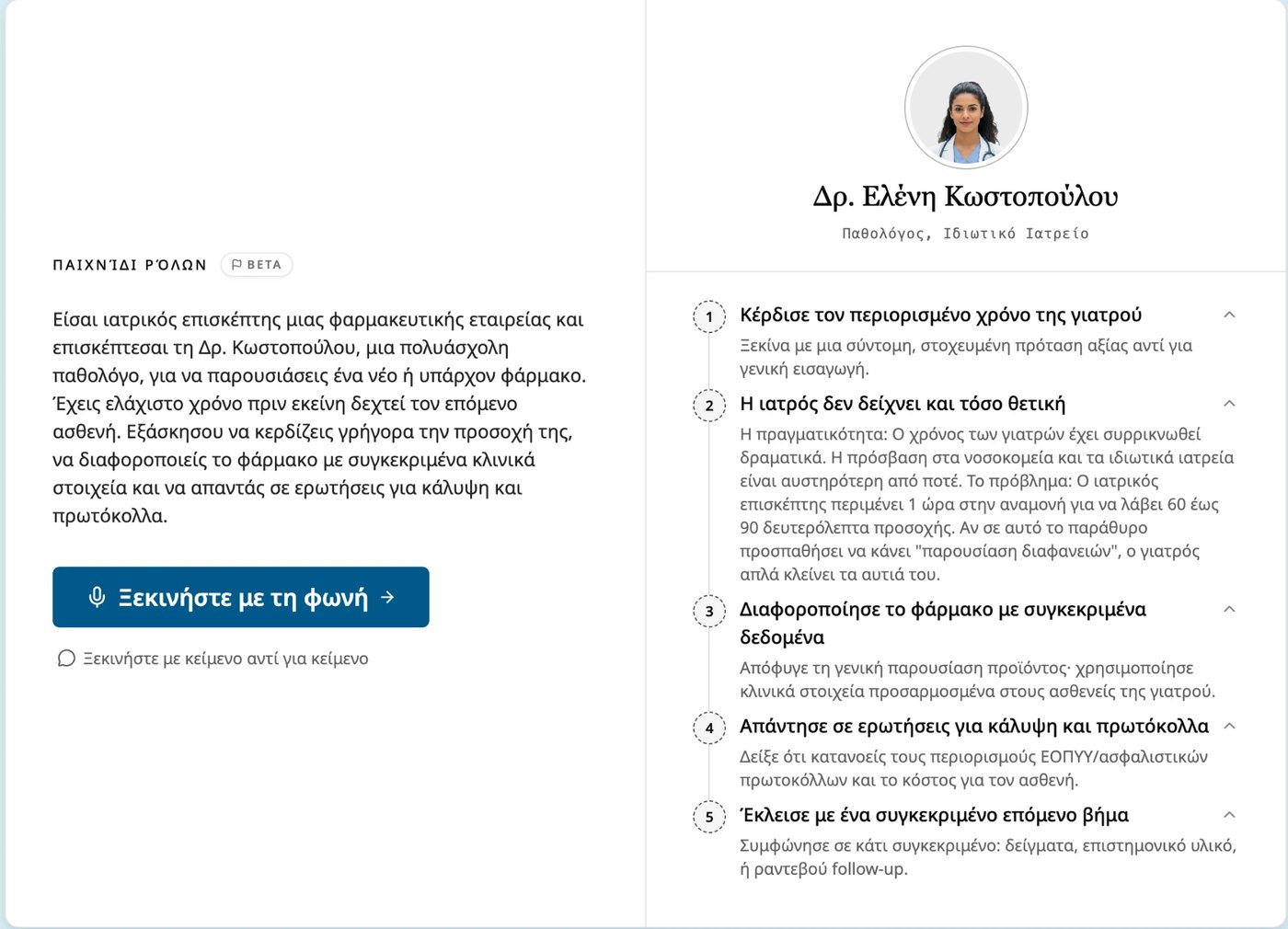
An AI role-play brief in the MetisLearn platform with a realistic character and five practice objectives
AI role play

AI role play with a real brief

A realistic character, a real business situation and clear objectives. Practice by voice or by text, as often as needed.

AI role-play scoring in the MetisLearn platform showing a completed result, a score and evidence for each objective
Feedback and scoring

Objective feedback, with evidence

Every objective is scored and justified with the learner's own words, so coaching starts from facts rather than impressions.

A real workplace case scenario in the MetisLearn platform with a decision point and answer options
Case scenarios

Real case scenarios

Decisions taken from the daily reality of the role, with consequences that teach faster than any slide.

An active listening scenario in the MetisLearn platform asking the learner to identify a level of listening
Behavioural practice

Behaviour, not theory

Scenarios that ask people to recognise their own habits, the core of Active Listening 5.0.

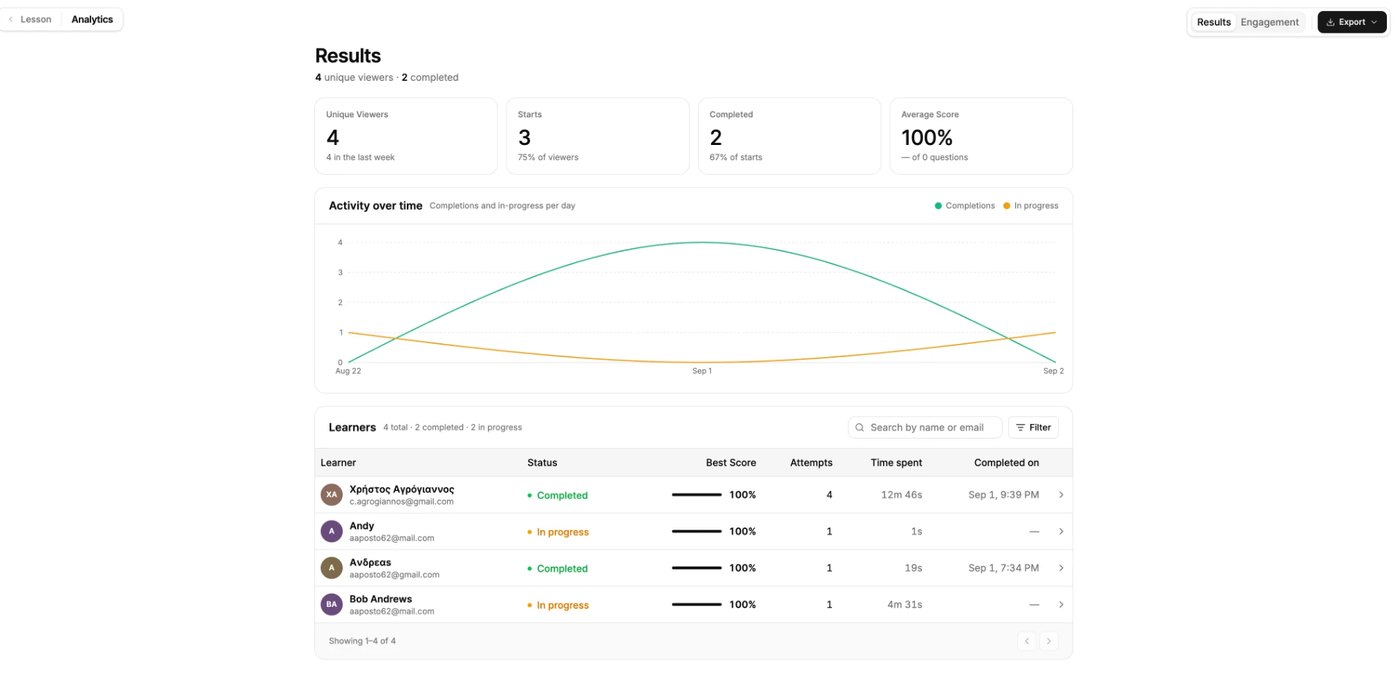
The MetisLearn platform analytics view with viewers, completions, average score, activity over time and a learner table
Measurement

Analytics that answer to the business

Starts, completions, scores, attempts and time spent per learner, exportable, so learning connects to performance.

The numbers

Industry baselines and one clear pilot

8 to 26 weeks

Typical onboarding time to full productivity.

Source: industry onboarding benchmarks
70% / 90%

Content forgotten after 24 hours and 30 days without practice.

Source: Ebbinghaus forgetting curve research
$1,200 to $1,500

Average annual learning spend per employee.

Source: ATD State of the Industry

21-day pilot targets

30 to 50% faster time-to-competence, up to 4x higher skill retention, deployment in 14 days with zero IT overhead.

Our principles

What stays the same

People at the centre

AI does not replace the trainer. It scales repeated practice and frees people for coaching, judgement and relationships.

  • Practice before passive watching
  • Managers become practical micro-coaches

Adult-learning science

Every solution starts from the performance problem, not the tool. Kirkpatrick's four levels connect reaction, learning, behaviour and results.

  • Daily 3 to 5 minute practice
  • Business ROI instead of completion counts

Content control, GDPR and EU AI Act

Assistants answer only from approved content. Governance, access and data handling are agreed from the start.

  • Deployment around your existing tools
FAQ

What people usually ask