
Methodology · L&D 5.0
A performance architecture, not another training intervention
MetisLearn is a Human + AI L&D 5.0 performance system. Seven phases connect business diagnosis, micro-interventions in real time, guided practice, behavioural reinforcement and measurable business impact into one closed loop: what we measure at the end becomes the diagnosis of the next intervention.



The MetisLearn differentiation
MetisLearn is not another course catalogue or eLearning platform with a beautiful interface. It is a performance accelerator aimed at the real cost of slow adaptation, weak execution, slow onboarding, skill gaps and training nobody can measure. We do not just train people. We accelerate their ability to perform.
- More courses becomes people who perform.
- Passive content becomes practice and micro-coaching.
- A beautiful user interface becomes a performance accelerator.
- A content provider becomes a business capability partner.
The shift we deliver is the move from “I attended training” to “I can perform better”: human-centred learning design, AI-assisted practice and feedback, micro-coaching in the flow of work, role-based journeys, fast onboarding and reskilling, and dashboards for capability, readiness and performance impact.
Phase 1 in practice: DNA, our business diagnostic tool
A traditional Training Needs Analysis asks people what training they would like and ends up with a list of general wishes. Our DNA, Development Need Analysis, reverses that logic. It asks which business challenge has to be solved and which KPI has to move, so learning is treated as a business investment with measurable return.
The four pillars of the DNA
- Business alignment. Learning is tied to specific problems such as a low conversion rate or a long time-to-productivity for new hires, not to training hours.
- Proof of impact. Success indicators are agreed in advance: hard KPIs, for example a 12% increase in cross-selling next quarter or three weeks off onboarding time within six months, and behavioural KPIs that must be observed in the field.
- Context mapping. We analyse the daily reality of learners: how much time they genuinely have, whether they work in the field or in an office, and what gets in their way.
- Execution gap diagnostic. We examine why previous initiatives failed, whether through lack of time, theoretical content or no manager follow-up, so the same mistakes are not designed back in.
The seven implementation phases
The phases are not a linear checklist. Phase 7 feeds Phase 1, which is what makes the system a closed loop: diagnosis, proof, diagnosis again.
01 · Diagnose: Diagnostic alignment and root-cause isolation
Before a single line of content is written, we isolate the real friction point: unclear expectations, missing capability, lack of time or resources, a broken system, or misaligned incentives. If the root cause is not a capability gap, we decline the training request and point leadership to the operational fix that will actually improve performance.
Scientific basis. Andragogy: adults need the why before they invest time. It also protects cognitive capacity from training that solves nothing.
In practice. A retail chain asked for sales training after a drop in sales. The diagnosis showed a reward system that did not pay for the right behaviour, so we redirected the budget to fixing incentives.
02 · Micro-learn: Contextual microlearning in the flow of work
Long, disconnected interventions are replaced by short, mobile-first micro-units delivered inside the workflow. Learning is split into single-concept scenarios that serve immediate application rather than passive memorisation.
Scientific basis. Sweller's Cognitive Load Theory: working memory processes only a few new items at a time, so we design small, focused units.
In practice. A bank's two-hour mandatory compliance course, which staff simply clicked through, became ten three-minute units, each tied to one transaction scenario, available on mobile at the moment of need.
03 · Simulate: Deliberate practice and AI simulations in a safe sandbox
Knowledge without execution is not enough. Learners rehearse conversations, sales pitches and operational workflows in an AI-supported sandbox and receive immediate feedback on performance and behavioural detail before they face the real situation.
Scientific basis. Behaviourism, learning through repeated action and immediate feedback, combined with constructivism, exploring and making mistakes where error carries no real cost.
In practice. Hotel front-desk teams rehearse difficult conversations with dissatisfied guests through AI role-play that adapts difficulty and gives moment-by-moment feedback.
04 · Coach: Managerial micro-coaching activated
Managers shift from administrative supervisors to active performance coaches. Structured, high-impact micro-coaching mechanisms, such as three-question reflection prompts, let them reinforce new behaviour during regular check-ins without disrupting daily operations.
Scientific basis. Cognitivism: reflection prompts help people connect new behaviour to existing mental models. Andragogy: adults learn best from their own experience.
In practice. Sales managers in a software company use three reflection questions after every customer call: what went well, what they would change, what they will try next time. It takes two minutes.
05 · Embed: Behavioural reinforcement and habit formation
Automated nudges, memory prompts and practical checklists are placed directly inside daily business tools. This prevents relapse into old habits, so the work environment keeps prompting and rewarding the desired performance pattern.
Scientific basis. Behaviourism in its clearest form, reminder, repetition, reinforcement. It is also our answer to the learning curve: without reinforcement, a new skill fades.
In practice. In a manufacturing plant, a new safety procedure risked being forgotten after a few weeks, so a short checklist and automatic reminders were embedded in the existing shift system.
06 · Measure: Field observation of behaviour, not vanity metrics
We move past completion rates and satisfaction scores. We measure whether the target behaviour is happening in the field, using field observation, manager assessment and live operational data connected to the performance problem identified at diagnosis.
Scientific basis. This phase confirms whether knowledge actually became behaviour, rather than confirming that someone attended something.
In practice. In an insurance company, instead of counting e-learning completions, we tracked CRM data to see whether the new needs-diagnosis questions were really used in client meetings.
07 · Impact: Business impact confirmed and connected to ROI
Behaviour change is linked directly to business results: sales conversion, error reduction, customer retention or operational efficiency. We close the loop with leadership by proving tangible return on investment and refining the architecture from the performance data.
Scientific basis. The circle that opened in Phase 1 closes here: learning built on sound learning science translates into measurable business results, not only better knowledge.
In practice. In a pharmaceutical company we connected the new arguments used by medical representatives with regional sales data, so leadership could see the relationship clearly.
From microlearning to micro-coaching sprints: the LACR cycle
Micro-coaching is the natural next step after asynchronous microlearning, built on the learning transfer model and on spaced repetition. It moves the learner from acquiring knowledge to applying it systematically at work. We organise it in four consecutive stages, Learn, Apply, Coach, Reflect.
- L
Learn 3-5 λεπτά
One micro-unit, one skill.
- A
Apply 24-48 ώρες
One predefined micro-action at work.
- C
Coach 10-15 λεπτά
The experience, never the theory.
- R
Reflect 2 λεπτά
One written micro-commitment.
- Learn, 3 to 5 minutes. A short, targeted micro-unit on one specific skill, for example handling price objections.
- Apply, within 24 to 48 hours. One predefined micro-action at work while the learning is still fresh: “in your next meeting, use the pause technique before you answer the price objection”.
- Coach, 10 to 15 minutes. A session focused entirely on the experience of application, never on repeating the theory.
- Reflect. Every session closes with a clear micro-commitment: what will be applied, when and in what context.
Two delivery models
Model A, asynchronous audio or text micro-coaching. Zero friction and no calendar coordination. The learner sends a 60-second voice note after the field trial, and the coach replies within 12 hours with a two-minute coaching note and one deepening question.
Model B, a live 15-minute sprint. Two minutes on what was tried, five minutes exploring where application got stuck, five minutes on the one thing that changes tomorrow, three minutes to close and set the next micro-goal in the action plan.
The model does not depend on external coaches alone. To stay scalable, we train team leaders and managers as micro-coaches and give them ready three-question coaching prompts for every micro-module.
How people really learn, the science we design against
- Behaviourism, learning through action. Repeating a behaviour and receiving immediate feedback on whether it was done well.
- Cognitivism, learning through understanding. Building mental models, connecting new information to what is already known, and recalling it when needed.
- Constructivism, learning through exploration. Testing, making mistakes safely and adapting the approach.
- Cognitive load. Working memory handles only a few new items at once, which is why we design small focused units instead of dense seminars.
- The learning curve. More guidance at the slow start, guided practice through acceleration, reinforcement in the flow of work so the skill is retained.
- Andragogy. Adults want to know why, bring experience worth using, prefer real problems to abstract theory, and are moved by a sense of competence rather than external pressure.
We also avoid what the evidence does not support. The idea of fixed learning styles, that someone learns only visually or only by listening, is not confirmed by research, so we do not build programmes around it.
- 40% Practice and feedback
- 25% Application at work
- 20% Coaching and reflection
- 15% Content and theory
How we actually do it
- AI role-playPractice over passive watching
- 3 έως 5 λεπτάDaily micro-coaching on mobile
- Βασισμένο σε KPIBusiness ROI instead of completions
- < 14 ημέρεςZero friction deployment
- Με τον άνθρωπο στο κέντροAI scales drill, people coach
- Practice over passive watching. AI acts as a realistic practice partner, so tough sales objections and leadership moments are rehearsed with immediate feedback before a client sees them.
- Three-minute daily micro-coaching. Mobile interventions of three to five minutes that people apply on the job the same day.
- Clear business ROI. Completion percentages are replaced by time-to-competence, onboarding speed, error reduction and conversion rates.
- Zero operational friction. A plug-and-play framework that deploys around your existing processes and roles, with no six-month IT rollout.
- Technology that keeps the human element. AI scales the repetitive drill work, which frees managers and senior leaders for real coaching and strategy.
The numbers behind the approach
The cost of the problem, industry baselines
- Traditional onboarding takes 8 to 26 weeks to reach full productivity, costing 1.5 to 2 times annual salary in lost output during ramp-up.
- Employees forget 70% of traditional training content within 24 hours and 90% within 30 days when it is not practised or applied immediately.
- Companies spend an average of $1,200 to $1,500 per employee each year on generic platforms and training hours, yet 75% of managers are dissatisfied with their L&D function.
of content forgotten within 24 hours without practice
forgotten within 30 days when nothing is applied
of managers are dissatisfied with their L&D function
Target impact metrics for a 60-day pilot
- 30% to 50% reduction in time-to-competence, moving new hires to full productivity in 14 days instead of 30 by replacing passive video with daily three-minute scenario practice.
- Up to 4x higher skill retention, lifting behavioural application from the usual 10% to 40% or more with micro-coaching at the moment of need.
- 80% faster deployment with zero IT overhead, launching role-based journeys in under 14 days instead of three to six months of custom integration.
Baselines are industry figures. Pilot metrics are target benchmarks: in a 60-day pilot we measure your current onboarding timeline against them to quantify the saving before full deployment.
Examples by sector
- Retail, diagnosis. Falling sales and a request for sales training turned into a redesign of the incentive system.
- Banking, microlearning. A two-hour compliance course became ten three-minute mobile units, one per transaction scenario.
- Hospitality, simulation. Front-desk teams rehearse difficult guest conversations in AI role-play with adaptive difficulty.
- Software, micro-coaching. Three two-minute reflection questions after each customer call.
- Manufacturing, reinforcement. A safety checklist and automatic reminders embedded in the daily shift system.
- Insurance, measurement. CRM data showing whether new needs-diagnosis questions are used with real clients.
- Pharmaceuticals, impact. New representative arguments linked to regional sales data for leadership.
The seven phases, as learners actually see them
Micro-learn, simulate, coach and measure are not concepts on a slide. These are the real screens behind each phase.
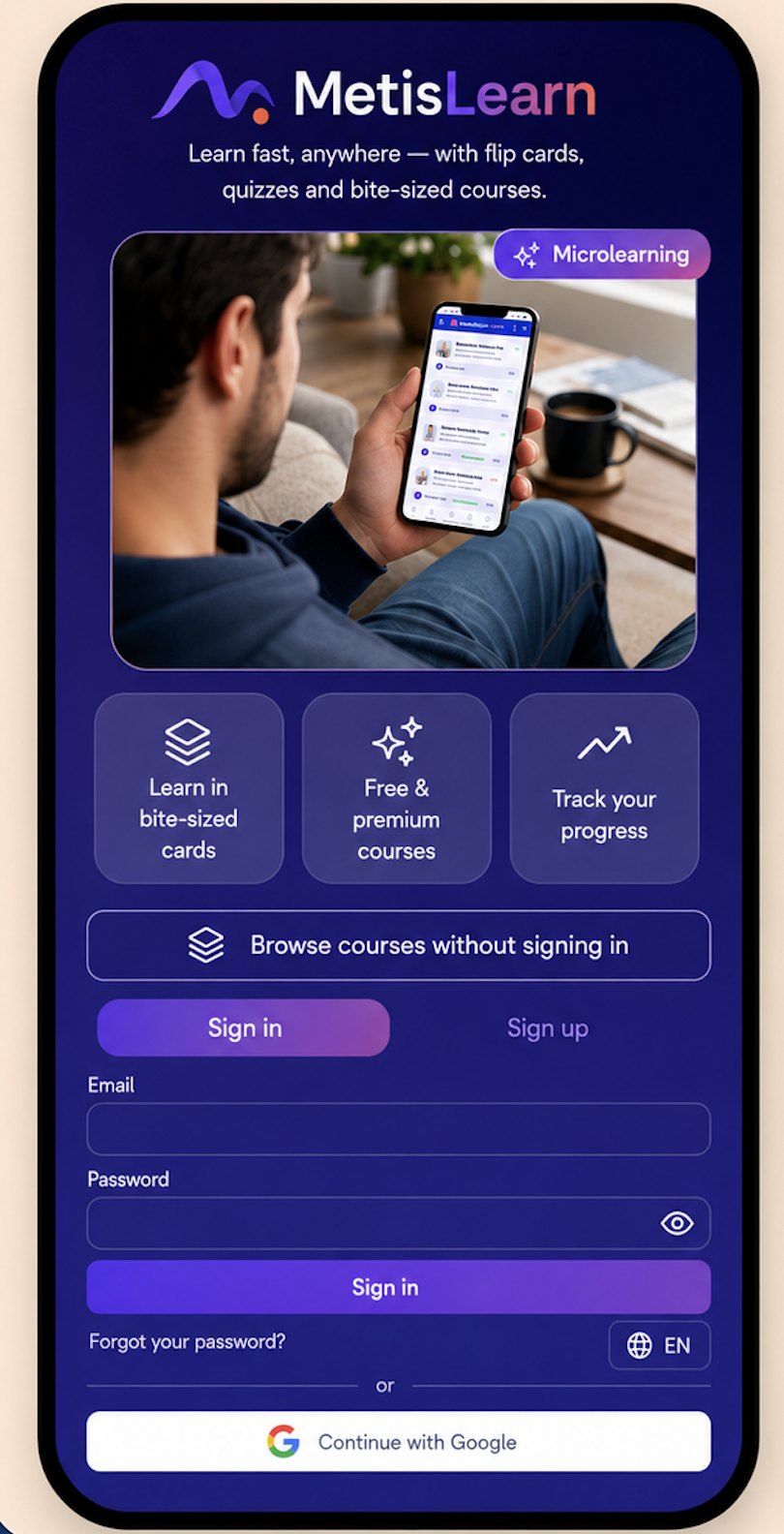
Microlearning on the phone
Flip cards, quizzes and three-minute lessons people finish between two meetings, with progress tracked.
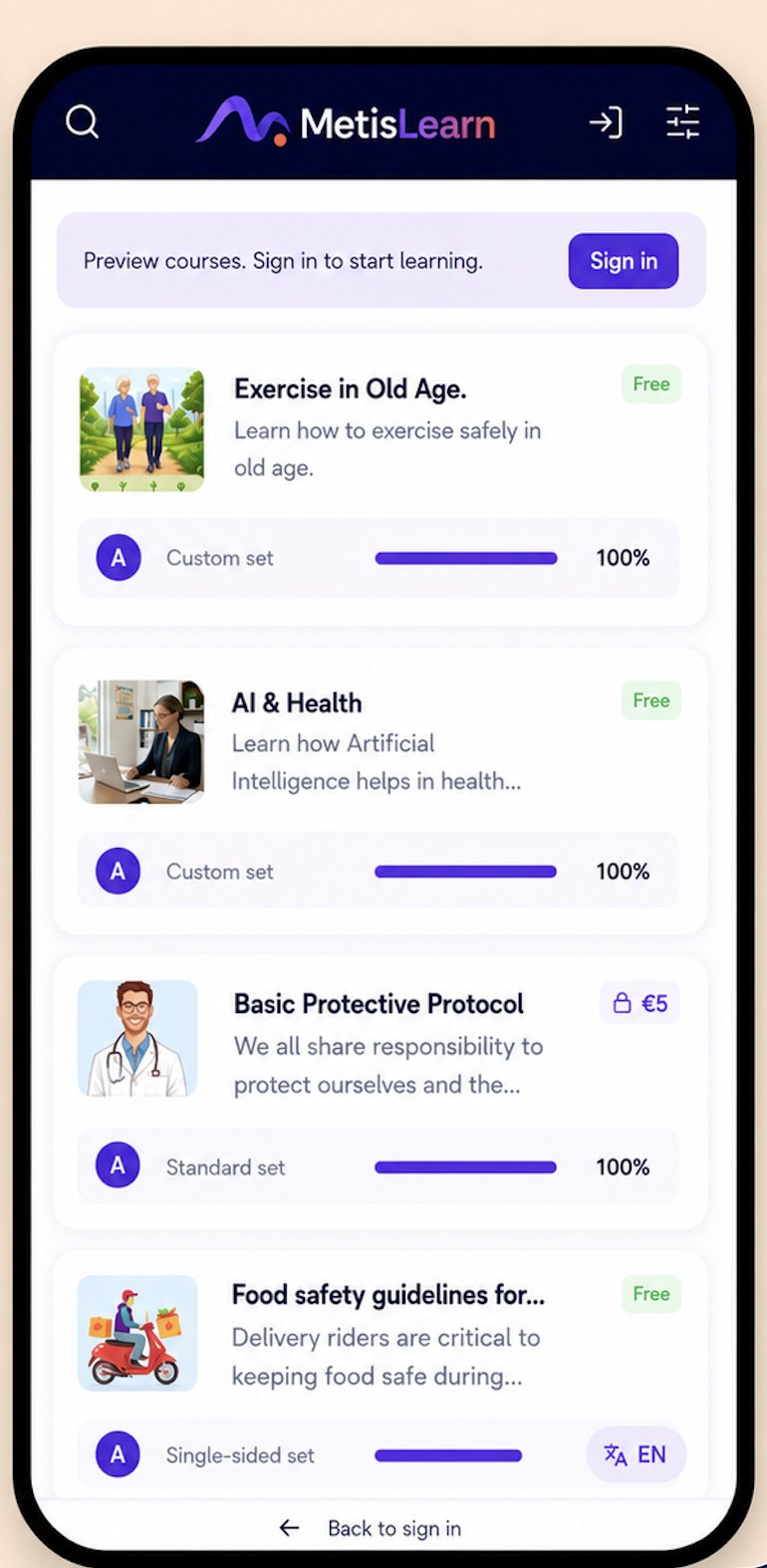
A live course library
Role-based courses, free and premium, in Greek or English, with completion visible for every learner.
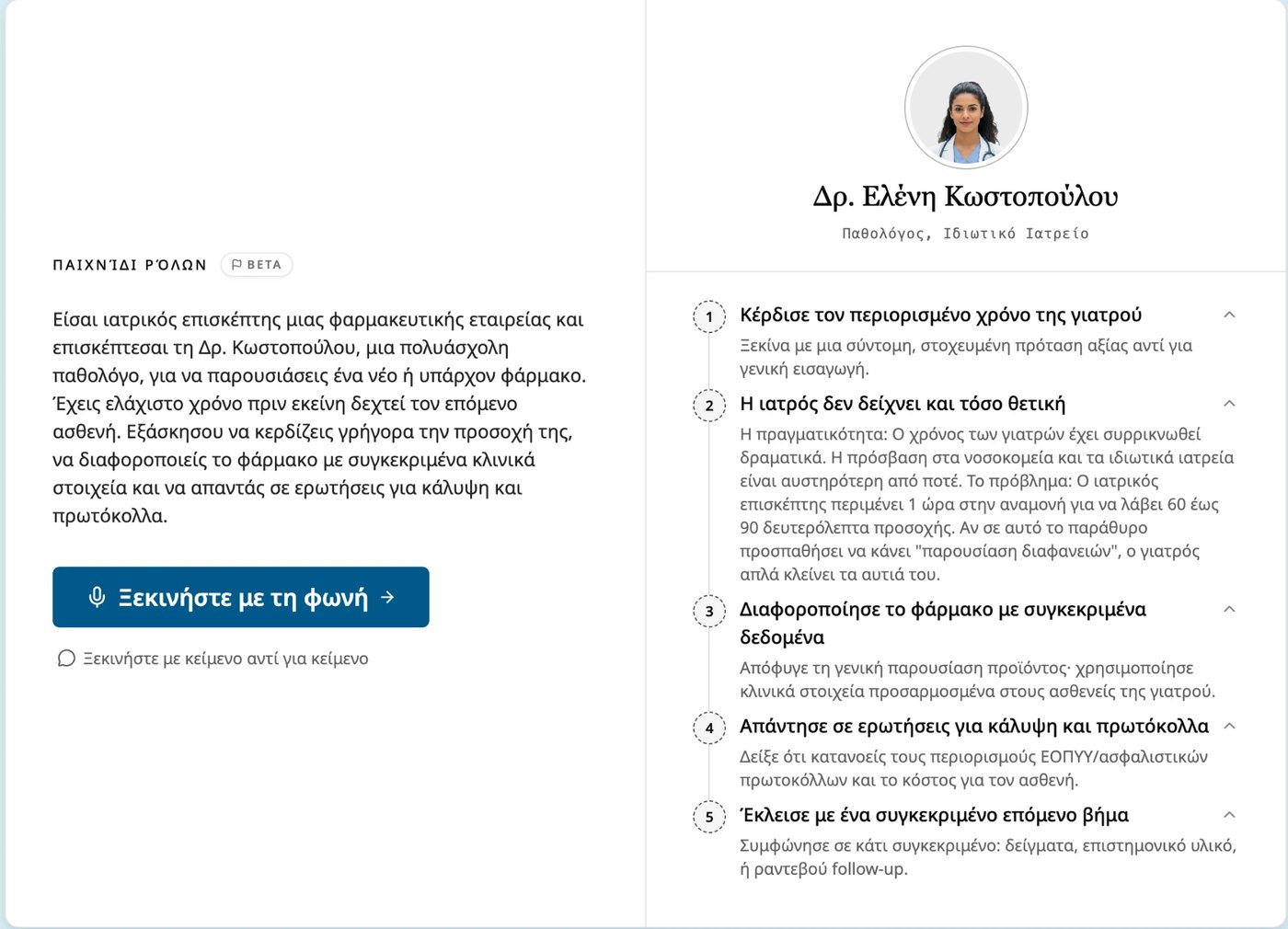
AI role play with a real brief
A realistic character, a real business situation and clear objectives. Practice by voice or by text, as often as needed.
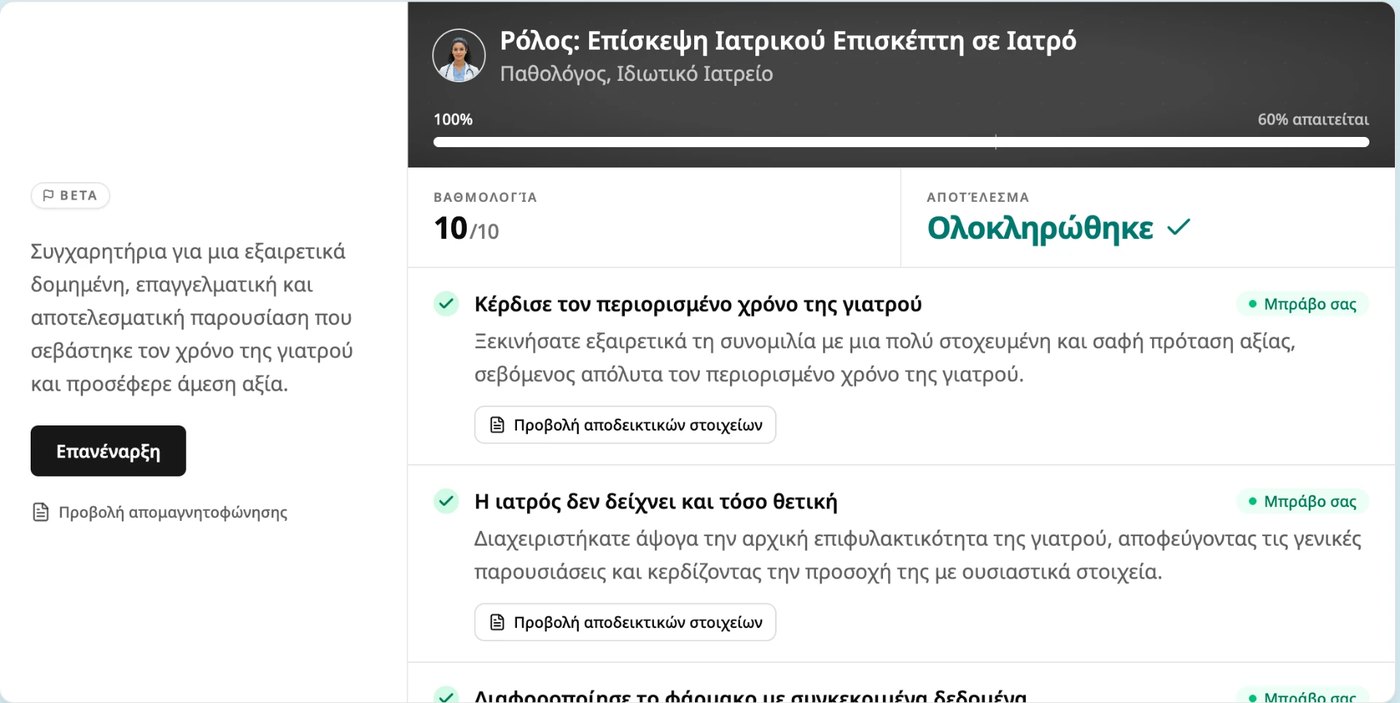
Objective feedback, with evidence
Every objective is scored and justified with the learner's own words, so coaching starts from facts rather than impressions.

Real case scenarios
Decisions taken from the daily reality of the role, with consequences that teach faster than any slide.

Behaviour, not theory
Scenarios that ask people to recognise their own habits, the core of Active Listening 5.0.
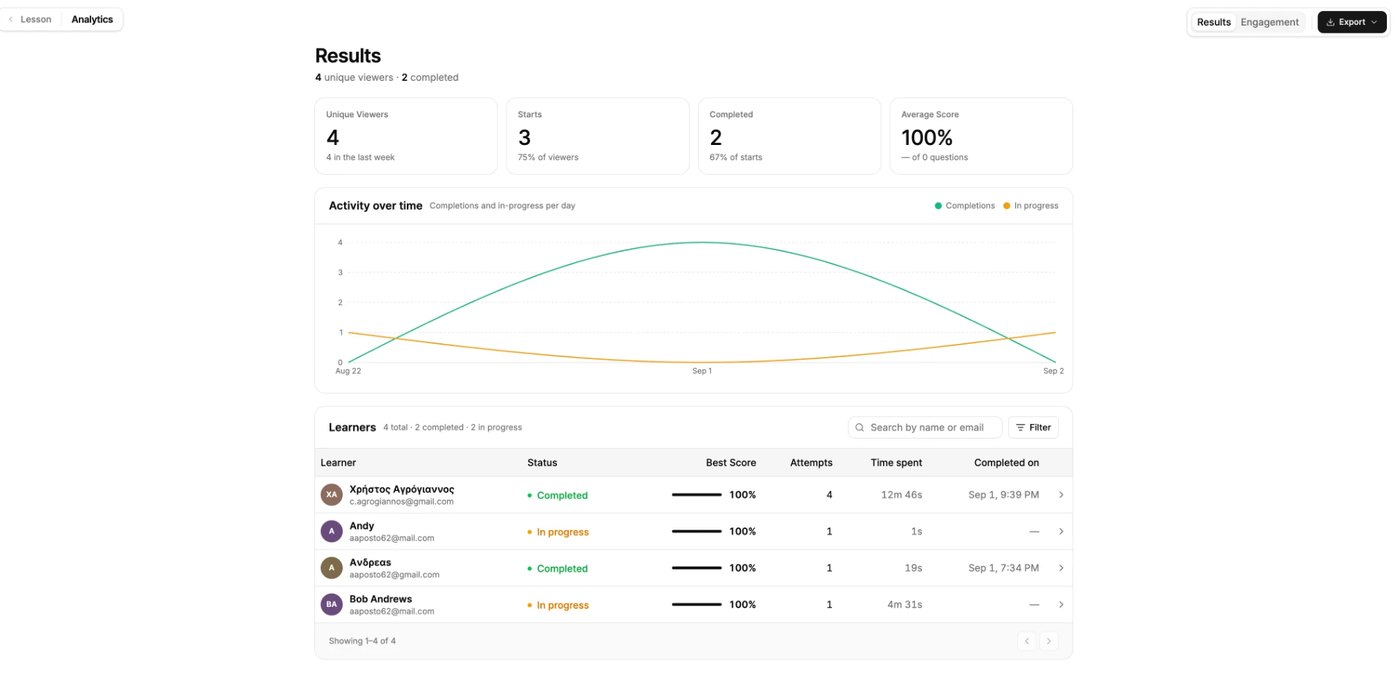
Analytics that answer to the business
Starts, completions, scores, attempts and time spent per learner, exportable, so learning connects to performance.
Start with the business problem.
A DNA diagnostic tells us which KPI has to move before any content is designed.